For my keynote at the Vision 2020 Financial Services conference last month in Mumbai I prepared some ‘quick and dirty’ scenarios for the global financial services industry landscape in 2020 from a technology perspective. Below is an overview of the content I used in my presentation. The complete slide deck from my keynote is also available, though it needs the explanation as below.
WARNING: These are scenarios prepared for a presentation, so they are far from rigorous or comprehensive. True scenarios should have fully developed storylines that evoke the richness of how the scenario unfolds and could actually happen. To be truly valuable, scenarios need to be created for a specific organization or strategic decisions – generic scenarios are of limited value. Always work with someone highly experienced in the field – most consultants that claim to do scenario planning are making it up. The Driving Forces and Critical Uncertainties identified below are highly summarized, and would be presented and aggregated very differently in a real scenario project. OK warning over, on with the content…
Scenario planning
Scenario planning recognizes that beyond a certain degree of uncertainty forecasting is of limited value (or can even be detrimental to good decisions). The process of creating a set of relevant, plausible, and complementary scenarios (more than the scenarios themselves) can be invaluable in creating and implementing effective, responsive strategies.
The heart of the scenario planning process is distinguishing between Driving Forces (consistent long-term trends) and Critical Uncertainties (unpredictable elements). Once these are identified, they are brought together to create a set of scenarios that reflect both what you know and what you don’t know about how the environment will change.
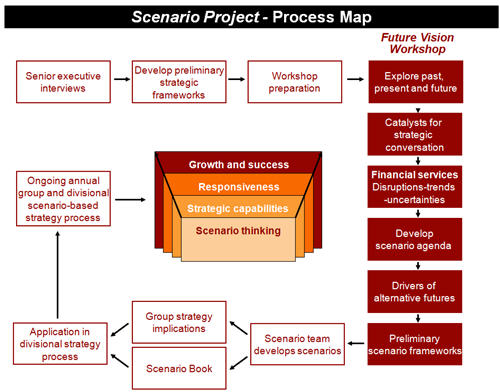
The image below shows a sanitized version of the process for a scenario planning project I ran for a major financial institution. This was quite a streamlined process relative to a comprehensive scenario planning project, however was designed to bring the insights directly into the existing group and divisional strategy process.
Below are the scenarios in detail:
- Driving Forces: Global Financial Services
- Critical Uncertainties: Global Financial Services
- Scenario Framework for Global Financial Services
- Four Scenarios for Global Financial Services
DRIVING FORCES: GLOBAL FINANCIAL SERVICES
1. Economic shift

Economic power is shifting to the major developing countries. The BRIC countries (Brazil, Russia, India, China) together host close to half the world’s population, and their pace of economic development means that before long there will be multiple economic superpowers. In addition, global economic growth is shifting to the virtual, and developing countries will gradually wean themselves from primary and secondary industries to be significantly based on knowledge-based services.
Read more →


Scenario planning: strategy for the future of global financial services
By Ross DawsonFor my keynote at the Vision 2020 Financial Services conference last month in Mumbai I prepared some ‘quick and dirty’ scenarios for the global financial services industry landscape in 2020 from a technology perspective. Below is an overview of the content I used in my presentation. The complete slide deck from my keynote is also available, though it needs the explanation as below.
Scenario planning
Scenario planning recognizes that beyond a certain degree of uncertainty forecasting is of limited value (or can even be detrimental to good decisions). The process of creating a set of relevant, plausible, and complementary scenarios (more than the scenarios themselves) can be invaluable in creating and implementing effective, responsive strategies.
The heart of the scenario planning process is distinguishing between Driving Forces (consistent long-term trends) and Critical Uncertainties (unpredictable elements). Once these are identified, they are brought together to create a set of scenarios that reflect both what you know and what you don’t know about how the environment will change.
The image below shows a sanitized version of the process for a scenario planning project I ran for a major financial institution. This was quite a streamlined process relative to a comprehensive scenario planning project, however was designed to bring the insights directly into the existing group and divisional strategy process.
Below are the scenarios in detail:
DRIVING FORCES: GLOBAL FINANCIAL SERVICES
1. Economic shift
Economic power is shifting to the major developing countries. The BRIC countries (Brazil, Russia, India, China) together host close to half the world’s population, and their pace of economic development means that before long there will be multiple economic superpowers. In addition, global economic growth is shifting to the virtual, and developing countries will gradually wean themselves from primary and secondary industries to be significantly based on knowledge-based services.
Read more →
Web 2.0 is happening inside organizations anyway – time to recognize it and do it well
By Ross DawsonThe current issue of MIS magazine Australia has an excellent feature on Corporate Web 2.0 titled Meetings of 2.0 Minds, introduced with the words: The social communication tools of the web are making their irrevocably into today’s enterprise.
The piece begins with the example of how Bond University conducted an audit of use of Web 2.0 technologies, and “uncovered a vast, organic network of technologies already being used…”
The article goes on to quote me:
Read more →
Future Files by Richard Watson hits global markets
By Ross DawsonA little while ago I announced that Future Exploration Network’s extraordinary Chief Futurist, Richard Watson, had released his book Future Files: A History of the Next 50 Years, including a few excerpts.
Since then it has sold at a giddying pace, selling out in Australia, and has now been launched in 10 editions worldwide, including two Chinese versions. The book has now been launched in the US and UK to great fanfare. The London book launch broke RSA’s record for most books sold, exceeding that for Clay Shirky’s event (see the event video).
Publisher’s Week in the US made Future Files its Web Pick of Week, saying…
Great to see Richard’s thinking getting out there! His talents and provocative insights are highly valued by Future Exploration Network’s consulting clients.
The steady shift to an RSS-based universe
By Ross DawsonThe Guardian is now providing full-text RSS feeds.
Let’s dig into why this is important, and an indicator of one of the broadest shifts happening in the information landscape.
Over the last few years RSS has shifted from a geek-thing that required explanation, to the point where most people have an RSS reader of some type on their desktops. As people go to more and more information sources, it becomes highly inefficient to visit to them separately, while an RSS readers allows all of your selected information sources to be found in the one place.
Currently virtually every professional publisher provides partial feeds, meaning that if you subscribe to their news feeds in an RSS reader you only get an excerpt or the beginning of the article, and you have to click through to the publishers’ website to read the article. For some years there has been a vigorous debate on whether publishers should provide full or partial feeds. Professional publishers have almost always chosen to direct readers back to their sites, where they can ply them with advertising and make money.
The Guardian is in fact the first major newspaper in the world to provide full-text feeds, according to the Google Reader team.
Read more →
Expertise location: linking social networks and text mining
By Ross DawsonA very interesting article in the Guardian today, US military targets social nets, describes new expertise location technologies.
Expertise location has always been a central ‘killer app’ first sought by knowledge management and now part of the promised of Web 2.0. It is a fundamental driver in any large organization being able to tap its own capabilities and take advantage of being large. This was always epitomized by the quote from Lew Platt, who as CEO of HP famously said “If HP knew what HP knows, it would be three times more profitable!”.
I wrote in 2005 about how Morgan Stanley was finding that blogging was trumping in effectiveness its years of efforts into dedicated expertise location systems. The next layer is tapping social network and content creation patterns to identify experts, as has been implemented in some content management systems (CMS) over the last couple of years. This can be taken further when used within online communities and social networks, as SRI International is currently doing:
Read more →
Business models for micro-blogging in the enterprise
By Ross DawsonToday’s New York Times has an interesting article titled Start-Ups Test Dot-Com Business Models, which compares the business models of Twitter and Yammer (a recent start-up focusing on business micro-blogging that I wrote about in a recent review of the space).
It says that Yammer, while a tiny fraction of the size of Twitter, is already getting revenue, while Twitter is still focusing on growth and waiting to monetize.
Read more →
Detailed case study of Twitter in the enterprise: Janssen-Cilag
By Ross DawsonEarlier in the month I wrote a post on Micro-blogging in the enterprise: an idea whose time has come? I mentioned a number of the current corporate initiatives in the space, including those of Janssen-Cilag, which in February implemented an internal version of Twitter it called Jitter.
After my post I learned (on Twitter) that Janssen-Cilag was highly commended in the 2008 Intranet Innovation Awards. The executive summary of the report includes a description of Jitter. James Robertson from the Intranet Innovation Awards has also recently posted a seven-minute video interview of Janssen-Cilag’s Nathan Wallace on one of their other Intranet initiatives, Juice, for ordering IT supplies.
Last week Nathan wrote up in detail Janssen-Cilag’s experiences with micro-blogging, very generously sharing insights into the challenges as well as benefits from the initiative. This is a must read for anyone interested in the realities of implementing Web 2.0 and new communications technologies. Some selected insights from Nathan’s review:
Read more →
Smart Company names the top 15 business blogs in Australia – TLN makes the list
By Ross DawsonA great article in Smart Company on Australia’s best business blogs by Brad Howarth discussing the ins and outs of business blogging, and names the top 15 business blogs in Australia.
Trends in the Living Networks makes the list, which seems reasonable considering Wikio ranks us in the top 40 business blogs globally.
The article begins:
I’ve spoken and written many times before about how slow Australian business has been to embrace blogging. Fortunately we have come quite a long way, with a number of major corporates involved in the space, however I still believe that Australia is lagging, and there are many opportunities for those companies that do it well. I look forward to greater momentum on this front.
The article is definitely worth a read, with some great quotes from companies that are already getting benefits from blogging.
For the record, the top 15 list is:
Read more →
Seth Godin says write so it couldn’t be any shorter
By Ross DawsonHugh MacLeod has published a delightful interview with Seth Godin on the launch of his new book Tribes.
A couple of excerpts that particularly struck me:
Yes, very well put. That is the discipline we all must have today. As attention is spread ever more thinly, there is no luxury for padded content.
Yes again. I think we almost all find it hard to comprehend quite how much business has changed over the last 10 years. We now live in a very. very different world, and just about everyone at least implicitly recognises it. Almost all the change for the good, I think.
Micro-blogging in the enterprise: an idea whose time has come?
By Ross DawsonOver the last few months there has been increasing discussion of how micro-blogging tools such as Twitter could be used in organizations.
Twitter is now frequently used in external communication, with organizations as diverse as @SouthwestAir, @Comcastcares, @BigPondTeam, @SEC_Investor_Ed, and @mosmancouncil using Twitter to communicate to stakeholders and for customer service. Given the rapid rise of Twitter and how influential comments can be, this clearly needs to be on the radar for any major organization.
However there are significant constraints in using public micro-blogging services such as Twitter, Jaiku, or identi.ca for internal communication. Even with the ability to protect people’s updates to being viewed only by approved followers, few organizations would like to have this kind of information hosted externally.
As such they often look at internal tools to see how yet another consumer technology can be adapted to create value for the enterprise.
At our Enterprise 2.0 Executive Forum in February, Australian pharmaceutical company Janssen-Cilag described how it was implementing an internal version of Twitter.
Read more →