
Scenario Planning for Strategic Decisions
Scenario planning gives boards and executive teams a small set of plausible futures to test strategy against. Ross Dawson designs and facilitates scenario processes that stretch a leadership team’s thinking about its environment and turn the results into strategic initiatives.
Forecasting loses its value once uncertainty passes a certain point. Scenario planning works differently: it builds a small set of relevant, plausible, and complementary scenarios, and the process of building them matters as much as the scenarios themselves. At the heart of the method is a distinction between Driving Forces, the long-term trends that will hold regardless of how the future unfolds, and Critical Uncertainties, the elements that could go either way. Combining these creates a scenario set that stretches a team’s thinking without losing plausibility.
Ross’s Scenario Planning in Action framework sets out the objectives, success factors, and a generic process.
Audience: boards, executive teams, and strategy and risk functions preparing for a multi-year planning horizon.
Key content
Sessions follow a structured sequence, adapted to the group’s time horizon and industry.
- Driving forces and critical uncertainties. Separating what is predictable from what is not, as the foundation of the scenario set.
- Scenario matrices. Combining critical uncertainties into two or four internally consistent scenarios.
- Scenario development. Fleshing out each scenario into a plausible, distinct narrative of the future.
- Backcasting and implications. Working back from each scenario to the strategic options it implies today.
- Monitoring signals. Identifying the indicators that show which scenario is emerging.
Outcomes
Boards and executive teams leave with more than a set of documents.
- A shared view of the business environment. A common language for talking about an uncertain future.
- Strategic initiatives. Concrete actions identified through the scenario and backcasting process.
- Stronger strategic thinking. A capability that carries into ongoing planning rather than ending with the exercise.
- Early warning indicators. Signals the organization can track to see which future is unfolding.
Examples of recent work
A diversified financial institution engaged Ross and his team for a major strategy project examining the bank’s business environment seven years out. Ross designed a streamlined process that fed insights directly into the group and divisional strategy process. The work shaped top executives’ view of the changing financial landscape, produced significant strategic initiatives, and improved strategic thinking across top and middle management.
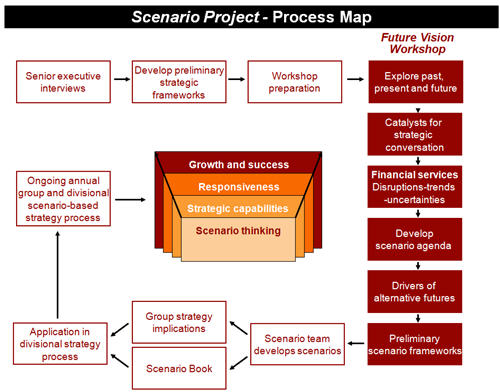
Outline of the scenario planning process designed for a diversified financial institution (sanitized)
A major bank brought senior stakeholders together to develop scenarios for its operations and identify emerging risks over the next three to five years. Ross worked with the risk management team to frame the issues and build the scenarios, then facilitated a workshop that established initiatives to address them.
An industry association needed a scenario project run entirely online, across stakeholders and experts in multiple time zones. Ross designed and facilitated the process using online collaboration tools and documented conference calls, producing a set of scenarios and the resulting strategy.
A state government’s senior leaders program wanted its cohort equipped with strategic foresight over two days. Ross took participants from driving forces and futures wheels through scenario matrices and scenario development to foresight in leadership, closing with implications for the government and personal action plans.
Formats
Scenario work scales from a single session to a multi-month project.
- Compact workshop. Half day to full day, producing a first scenario set.
- Multi-session scenario project. Run with a core team over several weeks.
- Scenario thinking within a strategy offsite. Integrated into a broader strategy session.
- Online delivery. For distributed stakeholders across time zones.
Part of Strategy facilitation and offsites.
About Ross Dawson
Ross Dawson is a futurist, strategy advisor, keynote speaker, entrepreneur, and author. He is the Founder of Advanced Human Technologies Group, whose ventures include the Humans + AI product suite and Fraxios, the AI-augmented strategy platform, and the bestselling author of Thriving on Overload and Living Networks. He has delivered keynotes and strategy sessions in 35 countries.
