Report from Neurotechnology Summit 2025 on the massive potential and dangerous pitfalls ahead
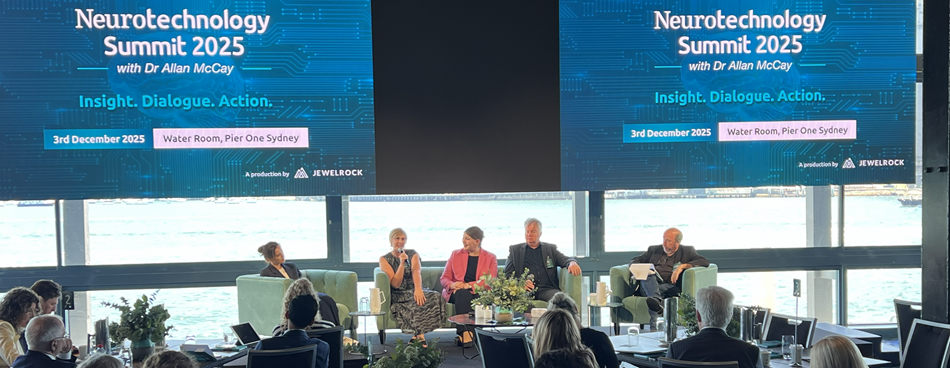
I attended the first day of Neurotechnology Summit 2025 in Sydney, with some fascinating insights and discussions through the day.
Australia is a world leader in the space, with Australian born or based leaders in neurotechnology including Synchron, Emotiv, Ultra Bionics, Omniscient Technologies, Cortical Labs, and Resonait, and the leaders of most of them speaking at the event.
My LinkedIn post provides a very high level view of the discussion, and is complementary to this piece in linking to the speakers and pointing to some of their specific contributions. Below is a more detailed description of the key insights from each session.
Nita Farahany – Duke University – The Battle for Your Brain
Non-invasive neurotech plus AI is rapidly moving toward real-time decoding and shaping of thought. fMRI with transformer models (GPT-1) has already reconstructed continuous language and imagined stories with striking accuracy, with similar techniques now tested on portable systems like fNIRS and EEG. Commercially, Meta’s neural interfaces and “brain foundation models” such as BrainLM/BrainWave and Synchron’s Chiral suggest BCIs that not only decode explicit intentions but also pre-conscious motor signals, enabling closed-loop neuromodulation where brains and models co-adapt—transformative for people with paralysis, but also a world where systems can act on subconscious activity before we’re even aware of intending to act.
The central risk shifts from data privacy to agency: when AI acts on subconscious neural signals and we naturally rationalise our behaviour afterward, we may not know whether our actions were truly ours. The proposed response is to embed fiduciary duties directly into the models handling brain data—a base brain-foundation layer that decodes signals, topped by a guardian layer whose reward functions are tied to loyalty, care, and confidentiality, continuously checking and sometimes blocking actions. Around that, a multi-layer governance stack—technical, institutional, legal, corporate, and international (e.g., UNESCO neurotech standards)—aims to protect cognitive liberty and self-determination rather than optimise primarily for engagement or profit.
Panel: Funding for Neurotech
Nicholas Opie, Cameron Higgins, Harikesh Pushpapathan, Brett Kagan, Michael Witbrock
Neurotech founders are shifting to a “patient-first” frame: deep brain stimulation and BCIs must move slowly, with long safety trials, consent, and continual clinical check-ins, not “move fast and break things.” Australia and NZ now have world-class science, engineers, hospitals, ethics committees, and early flywheels (Synchron → spin-outs), but capital is still misaligned—too concentrated in a few “safe hands,” applying software-style pattern matching to a domain with very different risks and timelines. The push is for more diverse, patient-aligned capital (government, family offices, smarter university pathways), more small early bets, and tighter vertical integration between labs, hospitals, regulators, and investors so that genuinely hard neurotech can actually get to patients.
At the same time, AI systems are cast as “inspectable brains”: mind-like models whose internals we can probe neuron-by-neuron, giving powerful tools for neuroscience but raising deep questions about copyright, freedom of thought, and who benefits from brain and behavioural data. Safety is seen as a long-term relationship: humans and conditions change, algorithms drift, and BCIs must be designed for continuous monitoring, adjustability, and the option to switch them off. Concerns about data colonialism and a handful of firms capturing the value of public and patient data fuel calls for public–private models, fairer sharing of IP from publicly funded research, and a more honest balance between futuristic implants and simple, underfunded fixes like basic accessibility.
Panel: Freedom of Thought
Allan McCay, Christina Maher, Lorraine Finlay, Kiley Seymour
Freedom of thought is defined as: not having to reveal your thoughts, not being punished for thoughts alone, not having your thoughts impermissibly modified, and a state duty to foster conditions for independent thinking. It sat dormant in human rights law for decades; AI and neurotechnology make it urgent, because brain data can now be measured, inferred, and influenced. Neurotech can expand freedom of thought (e.g. deep brain stimulation for OCD or depression, speech BCIs restoring communication) but also threaten it by exposing inner mental states that were never meant to be observable or punishable.
Consumer neurotech and gaming already collect rich EEG and behavioural data—often from children—mapping stimuli to brain responses under vague consent, drifting from “nudge” toward manipulation. Experiments show that merely knowing you’re surveilled changes how you process information, even if you feel unaffected, hinting at how neural surveillance could quietly reshape identity and dissent. Law is too slow and politically constrained to handle this alone, so the emphasis shifts to proactive safeguards: strict data minimisation (“collect less, transform more”), on-device processing and revocable biometric tokens, safety- and rights-by-design in products, strong cybersecurity, and serious public education for parents, teachers, and young people.
Michael Ivan – University of Miami – Applying Connectonimics
AI-based connectome mapping is transforming both brain tumour surgery and brain–computer interface (BCI) implantation. Using Omniscient’s software, his team fuses structural connectivity (tractography) with functional MRI to generate a patient-specific map of brain networks, including language, vision, emotion, default mode and executive function, even when anatomy is distorted by tumours or stroke. In tumour surgery they use this to identify “silent corridors” and navigate through augmented reality overlays in the OR, maximising resection while preserving cognition rather than just avoiding paralysis or loss of speech.
For BCIs, the same maps are used in reverse: instead of avoiding function, they target the densest, most useful nodes. Ivan’s early fully implanted 4-electrode BCI let a quadriplegic patient control an exoskeleton, walk trainer, and even a car, and sparked long-term home use. As a Neuralink surgical site, his team now implants the N1 device with over 1,000 cortical electrodes, using connectomics to place threads not just on the “hand knob” but in high-yield sulcal motor regions, dramatically improving bit-rates for cursor control and enabling patients to play games, create digital art, run music schools, and control assistive robotic arms—even regaining expressive hand gesturing. Next trials aim at restoring vision and speech (laryngeal areas), then more complex networks (memory, anxiety, executive function), with Ivan explicitly framing his role as restoring lost function while broader society develops ethical boundaries around enhancement.
Panel: Applications and Innovations
Stephen Scheeler, Brett Kagan, Jeffrey Rosenfeld, Christina Maher
Engineers aim to make neuromodulation and deep brain stimulation far safer, less invasive and more adaptive so millions with conditions like chronic pain, depression, anxiety and obesity can benefit as their diseases evolve. Cortical Labs grows living neural networks from human cells and interfaces with them in real time, using them first for disease modelling and basic neuroscience and ultimately as a new “wetware” intelligence alongside silicon AI. New brain-based authentication systems use brain activity as a biometric that is harder to spoof and can be revoked, but still need ways to ensure user intent and robust de-noising and hardware.
Consumer neurotech and gaming platforms already collect vast streams of neural and behavioural data, creating opportunities for education and clinical insight but also powerful, largely unregulated tools for profiling and manipulation, while implants are expected to remain mainly for serious medical need and wearables for diagnostics and everyday augmentation. Connectomics and “large brain models” map higher-order networks for attention, memory, emotion and executive function, underpinning new tools for neurosurgery, deep brain stimulation, TMS and BCIs, and may eventually converge with large language models and robotics. Across implants, wearables and military applications, informed consent, long-term device support, equity of access, rights over brain data and the possibility of building AI systems that protect rather than threaten humans are framed as central design questions rather than afterthoughts.
Panel: Commercialisation
Cameron Higgins, Harikesh Pushpapathan, Jeffrey Rosenfeld, Mahendra Samarwickrama
Australia has deep strengths in Neurotech, from cochlear implants and Synchron through to new companies like Saluda and EpiMinder, alongside a growing wave of non-invasive technologies such as next-gen EEG, fNIRS headbands and thought-to-speech systems for people with severe disabilities. Non-invasive devices are moving faster commercially, while implantables face 10-plus-year timelines, heavy capital requirements, complex manufacturing, and the need to spin out of universities into vehicles investors can back. Success depends on staging clear milestones that de-risk the venture, building a coherent capital path (private, IPO, or acquisition), and lifting investor understanding of how value is created in Neurotech, which is very different from biotech drugs.
A genuine ecosystem is critical: interdisciplinary collaboration between clinicians and engineers, strong university–industry links, manufacturing capability, and deliberate talent pipelines from students into Neurotech startups. Australia already has many of the ingredients but needs a clearer narrative that positions Neurotech as a national strength, similar to quantum. Ethically and legally, a risk-based, principle-driven approach is favoured—starting with shared language and standards (e.g. around agency, dignity, “freedom of thought”) and growing into regulation where necessary. The main bottlenecks are capital, commercialization know-how, and coordinated ecosystem building, rather than regulation itself.

