
Futurist > Companies creating the future > AI and the expert network industry
15 leading companies using AI to reshape the expert network industry
Expert networks are businesses that connect organizations facing a difficult decision with vetted practitioners who hold firsthand knowledge unavailable in reports or public research. An investor, consultant or corporate team books time with a specialist, from a single hour to a multi-month engagement, to hear directly from someone who has done the work. The clients are mostly investment firms, private equity, consultancies and large corporates.
The core model hasn’t changed for 25 years, but now AI is dissolving that model from several directions at once. The unit of value is moving from a person’s billable hour to a queryable, reusable asset, and that change reshapes how organizations buy knowing. This article maps the fifteen companies driving the shift, across three segments, and the four trends that connect them.
The shape of the market
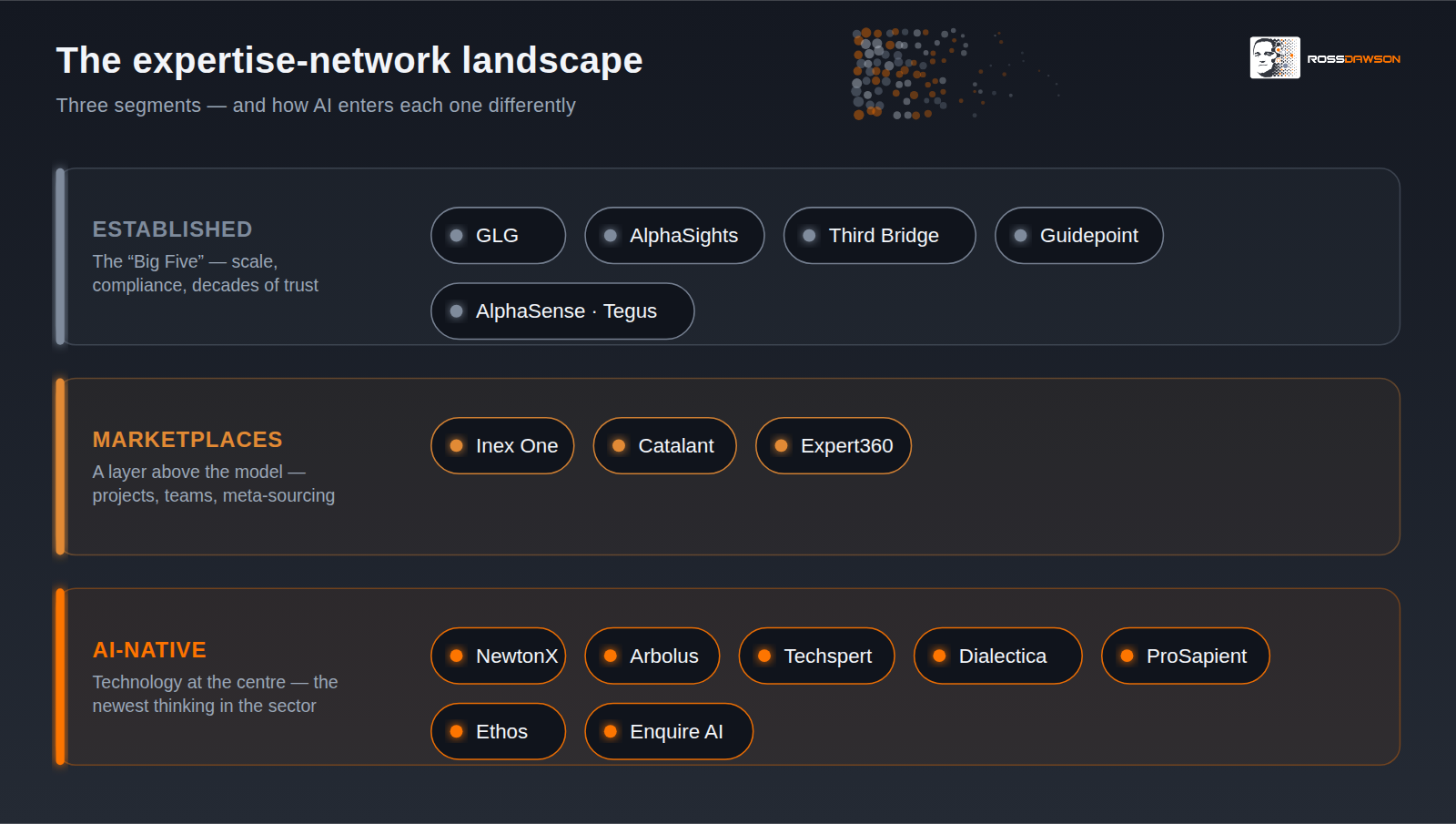
At the center are large, established networks with expert pools running into the hundreds of thousands or millions and compliance infrastructure built over decades: GLG, AlphaSights, Third Bridge, Guidepoint and AlphaSense, which absorbed the transcript provider Tegus in 2024.
Around them has grown a second tier of marketplaces and aggregators that connect clients to consultants for longer project work or offer access to several networks through one interface: Inex One, Catalant and Expert360.
Beyond these, a newer generation of AI-native challengers was built with technology closer to the core from the start: NewtonX, Arbolus, Techspert, Dialectica, proSapient, Ethos and Enquire AI.
How AI enters each segment
AI is present across all three segments, but the nature of adoption varies by company type, stage and ambition. In the established tier, it mostly accelerates existing workflows, through faster matching, automated compliance screening and AI-assisted summarization, real improvements that leave the core product intact. In the marketplace segment, it takes on a harder problem, matching clients not just to individual experts but to the right network or team. In the newest cohort, it does something more fundamental, questioning how expert pools are built, how expertise is described, and what the research process itself should look like.
Four trends reshaping the market
1. From live calls to knowledge assets. The most significant structural shift is the move from expert networks as a scheduling business to expert networks as a knowledge business. Third Bridge built its reputation on a library of more than 100,000 moderated interview transcripts. AlphaSense’s $930 million acquisition of Tegus in 2024 rested on the same thesis, that archived human expertise, made searchable through AI, is worth more than the sum of the calls that created it. As AI makes these libraries more queryable, the one-hour live call increasingly competes with its own archived predecessors, and networks that invested in structuring their content are better placed than those that treated calls as transient.
2. Dynamic sourcing versus static databases. Traditional networks rest on a registered database of pre-vetted professionals. NewtonX and Ethos challenge this from different directions. NewtonX rebuilds its pool for each project, scanning more than 1.1 billion professionals on demand rather than drawing from a fixed list. Ethos attacks the quality of the underlying data, using AI voice agents to capture richer expertise profiles at onboarding rather than relying on job titles. Both reflect a belief that the static database produces a mismatch between who is registered and who is actually most relevant, and as dynamic sourcing gets cheaper, the advantage of a large pre-registered pool may shrink.
3. Team assembly, not just individual matching. Expert networks have historically connected clients with individuals. Catalant and others in the marketplace segment use AI to compose multi-person teams calibrated to a project, combining complementary skills, experience and availability. This is harder than one-to-one pairing, and as the tooling matures it is likely to spread. It also moves the value proposition from a research tool toward flexible workforce infrastructure, embedded in procurement and HR workflows rather than consumed project by project.
4. Expert data as infrastructure. A quieter shift is the move toward expert insight as a data layer rather than a service. Arbolus is the clearest example, built API-first so that expert data flows directly into clients’ own AI environments and automated decision pipelines rather than being read by individual analysts. As organizations build more capable internal AI systems, demand for structured, machine-readable expert insight as an input to those systems is likely to grow, repositioning some networks as data-infrastructure providers with different pricing, stickiness and integration dynamics.
Where each company stands
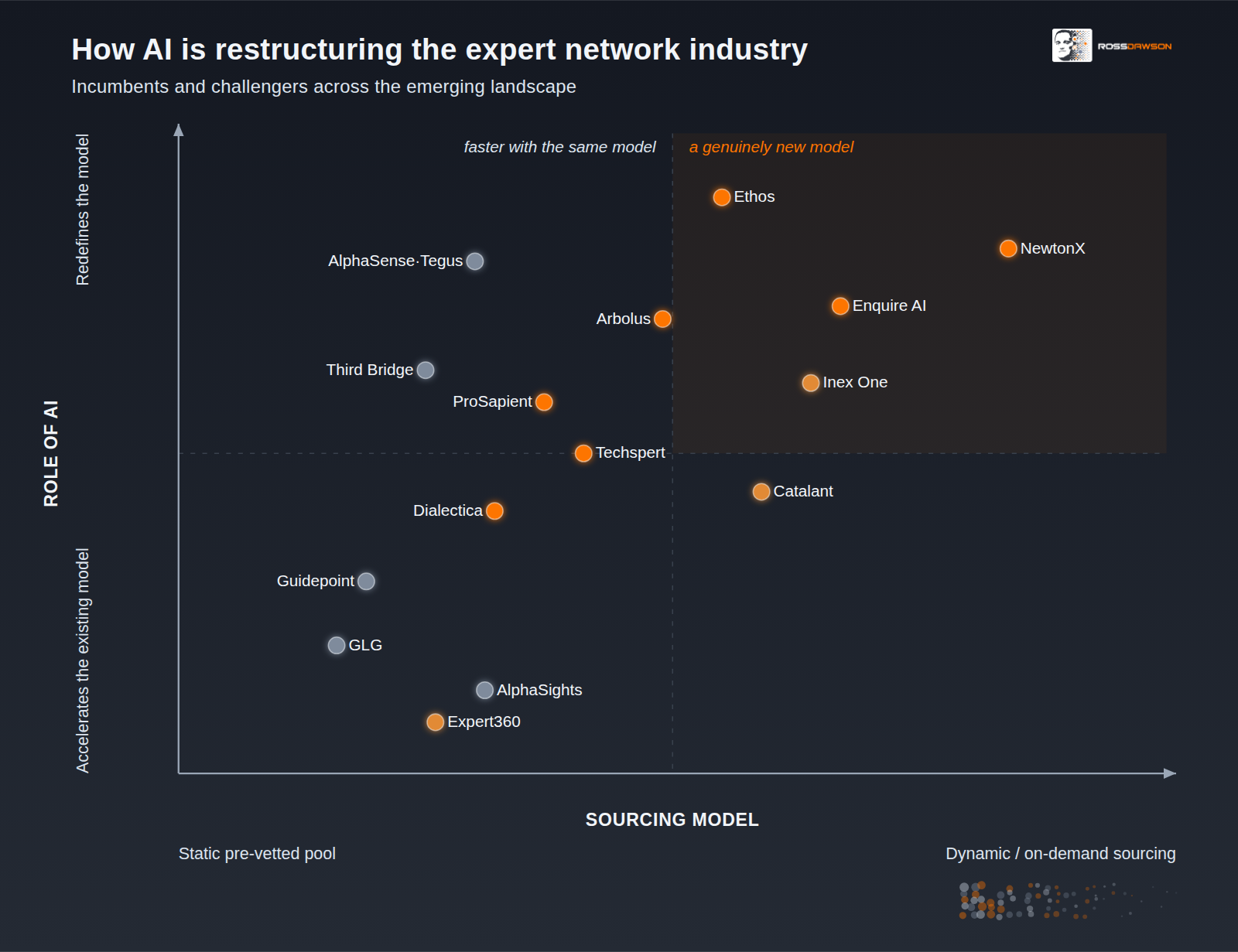
These four trends resolve into two underlying shifts, and every company can be placed against them. The first is how experts are sourced, from a static, pre-vetted pool at one end to dynamic, on-demand sourcing at the other. The second is what AI actually does, from making the existing model faster to redefining the model itself. Plotting the fifteen companies against these two axes shows where the real movement is. The established players cluster where AI accelerates a static pool, while the AI-native cohort pushes toward the corner where sourcing is dynamic and the model itself is being remade.
What this means
Taken together, these companies describe an industry redrawing its own foundations. The expert call is not disappearing, and the human practitioner with hard-won judgment remains the source of the value. Of course, the live conversation will not vanish, since some questions can only be answered by a person thinking in real time. What is changing is its place in the process, from the default first step to one option among several, called on when the archive, the survey and the synthesized answer are not enough.
The deeper move is from expertise sold as an event to expertise held as an asset, captured richly, stored in structured form, and made queryable by both people and machines. The networks that thrive will be the ones that treat every expert interaction as something that compounds, and that keep human judgment at the center of an increasingly automated pipeline. That is the same principle running through so much of how AI is reshaping knowledge work, where the greatest value comes not from replacing human expertise, but from making it accessible, reusable and augmented at a scale that was never possible before.
Explore the three segments in depth
5 leading established expert networks and how they are responding to AI
3 marketplaces and aggregators reinventing how companies access expert talent
